The Musician behind the instrument
A Pioneering Programme for Today’s Musician
The Musicians’ Wellbeing Programme introduces an innovative approach within classical music education, bringing together an exceptionally broad range of specialised practices and disciplines within one structured framework, all dedicated to supporting the contemporary musician as a whole.
From physical preparation and recovery, performance anxiety management and performance coaching to the Alexander Technique, Feldenkrais Method, Breathwork, Yoga, Tai Chi & Qigong, Physiovoice, specialised physiotherapy for musicians, Sound Therapy and the Tomatis Method, the programme recognises that a musician is more than a performer. The body, breath, nervous system, emotional resilience and artistic expression are interconnected and all play an essential role in a musician’s development and wellbeing.
What makes the programme distinctive is precisely this integration: approaches that are often encountered separately are brought together within a classical music education environment and incorporated into the musician’s development — from the early years of training through to professional life and performance.
In this way, we aim to redefine what it means to prepare a musician today. Musical preparation is not only about technical excellence and artistic development; it is also about body awareness, managing the demands of performance, developing effective ways to release accumulated tension, and building the physical and psychological resources needed for a healthy, creative and sustainable life in music.
Because behind every instrument, every voice and every performance, there is first a human being — and caring for that person should be an integral part of music education.
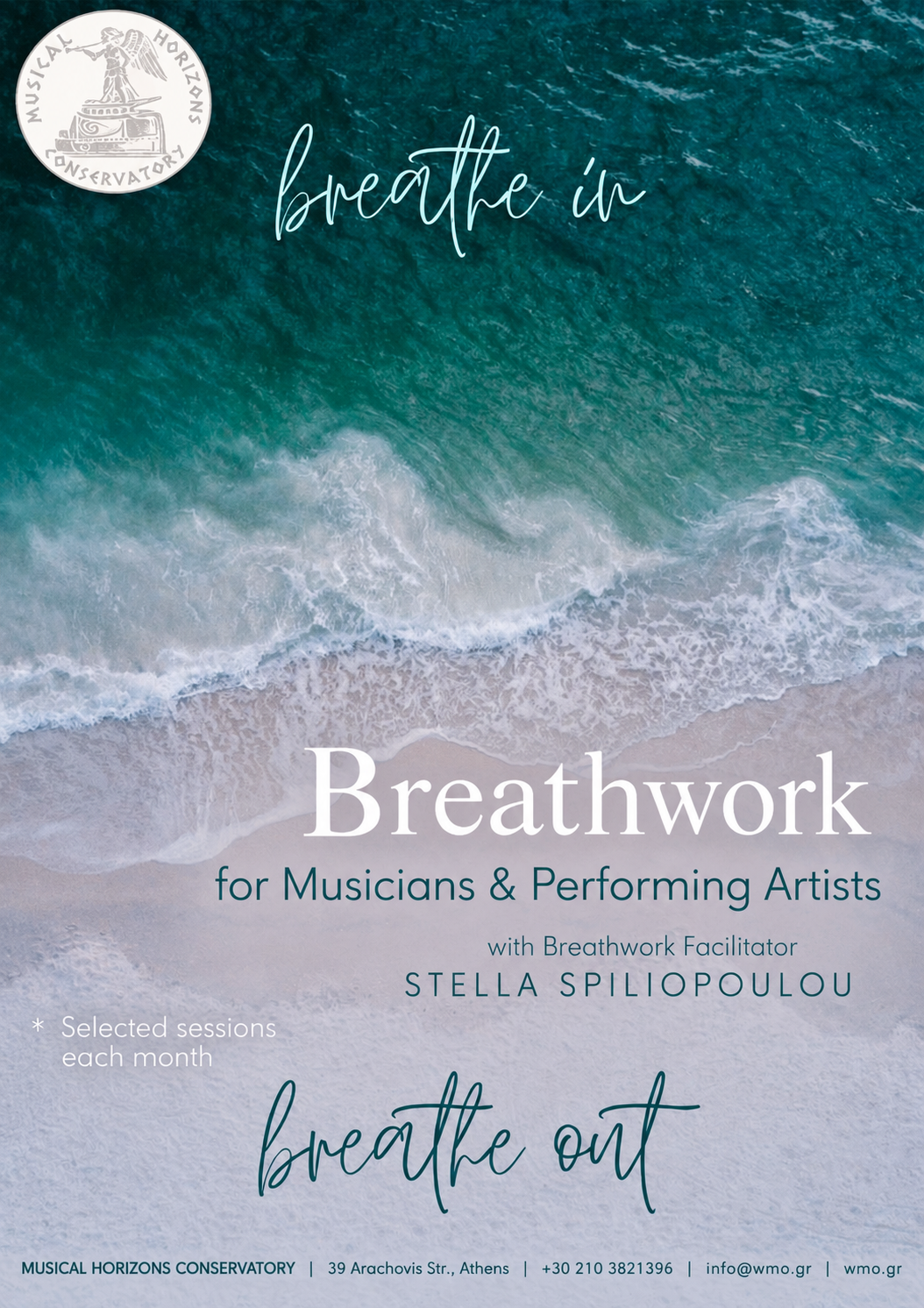
Breathwork for Musicians & Performing Artists
Breath as Music
Led by Breathwork Facilitator Stella Spiliopoulou
Breath is our first rhythm. It accompanies musical phrasing, dynamics, pauses, and movement. Yet, amid concentration, technique, and the pursuit of precision, we can lose touch with it: we may hold our breath without realising it, or try to control it so much that the effort itself becomes an obstacle.
This Breathwork class invites musicians, singers, actors, dancers, and performers to become more familiar with their breathing patterns. Through guided practices, we explore the breath as a way of returning to the body, the present moment, and artistic expression.
“When a passage becomes difficult, I hold my breath.”
For an instrumentalist, attention is often directed towards the fingers, the bow, the score, and the quality of the sound. Breathing can easily move into the background, particularly as speed or technical difficulty increases.
In the class, we observe what happens in these moments: how we breathe before we begin, what changes during a demanding passage, and how the body responds when we increase our effort. We explore ways of remaining connected to the breath while allowing our attention to continue serving the music.
Even when sound is produced through an external instrument, awareness of breathing can become a creative point of reference for musical phrasing, continuity, and silence.
“I think so much about how I’m supposed to breathe that I end up becoming tense.”
For singers, breathing is an essential part of vocal technique. However, the many instructions surrounding breath can sometimes develop into constant self-monitoring: “Did I take in enough air? Am I supporting correctly? Will I have enough breath for the phrase?”
Breathwork offers time to observe and explore breathing outside the demands of performance. We learn to recognise when preparation is accompanied by unnecessary tension and explore a more comfortable relationship with inhalation and exhalation, without forcing greater depth or duration.
This work is intended to complement vocal training. The aim is for singers to return to their technique with greater awareness and less anxiety around breathing, while also allowing the respiratory muscles — including the diaphragm, which is continuously active during singing — opportunities to release unnecessary tension and recover.
“On stage my breathing changes, and I feel as though I’m losing control.”
Before an audition, concert, or performance, breathing may feel faster, shallower, or simply less familiar. Trying to immediately force it back to what we believe is “correct” can become yet another demand placed on the body.
In the class, we practise gently observing these changes and returning to simple points of reference: contact with the ground, the movement of the body as it breathes, and the sensation of an easy exhalation. We explore practices that can become part of a personal preparation routine before going on stage.
For actors and singers, we also explore the transition from breath to speech and sound, with the aim of supporting expression without relying on continuous pressure in order to “be heard.”
What Does the Class Include?
Practices are adapted to the needs and comfort of each participant and include:
Observing the natural rhythm of the breath and recognising patterns of breath-holding or unnecessary effort.
Gentle guided breathing practices, with space for pauses and rest.
Connecting breath with body awareness, physical support, and movement.
Attention practices that help us return to the present when the mind becomes caught up in thoughts of judgement, evaluation, or fear.
Exploring the relationship between breath, musical phrasing, speech, and artistic intention.
Practices supporting a gradual transition into rest and recovery after practice, rehearsal, or performance.
Exploring emotional release through breathwork practices.
What Do We Cultivate?
The aim of the class is to develop a greater familiarity with our own breathing, recognise unnecessary effort, and build personal tools for concentration, preparation, and recovery.
We create space to listen to the body without constantly trying to correct it. To recognise when we need action and when we need a pause. To approach music and performance with greater presence, awareness, and availability.
A single breath before the first note can become a moment of connection with ourselves — and the beginning of our communication with the audience.