Part of the The Musician Behind the Sound Programme
This class is part of the comprehensive support programme for musicians and performing artists at Musical Horizons Conservatory. With particular attention to professional musicians and those preparing for a professional career, we connect artistic education with physical wellbeing, performance preparation, and the development of practical tools for managing the demands of a life in music. Our aim is to help musicians develop, from an early stage, the resources they need for a creative, healthy, and sustainable musical career.
The programme includes specialised physiotherapy for musicians, the Alexander Technique, the Feldenkrais Method, Tai Chi & Qigong, the Alfred Tomatis Method of Audio-Psycho-Phonology, Breathwork, Yoga for Musicians, Music Therapy, Performance Anxiety Management, preparation for auditions and concerts (Performance Coaching), as well as physical preparation and recovery techniques following practice, rehearsals, and performances.
Through classes and collaborations with specialised professionals, each participant can explore the type of support that best responds to their individual needs. Each approach maintains its own distinct educational or therapeutic role, while all are connected by a shared purpose: to care for and support the human being who creates — behind every sound and every performance.
Performance Anxiety Management
Physical Preparation, Stage Presence & Recovery for Musicians and Singers
“I can do it when I practise. Why does everything change when I’m on stage?”
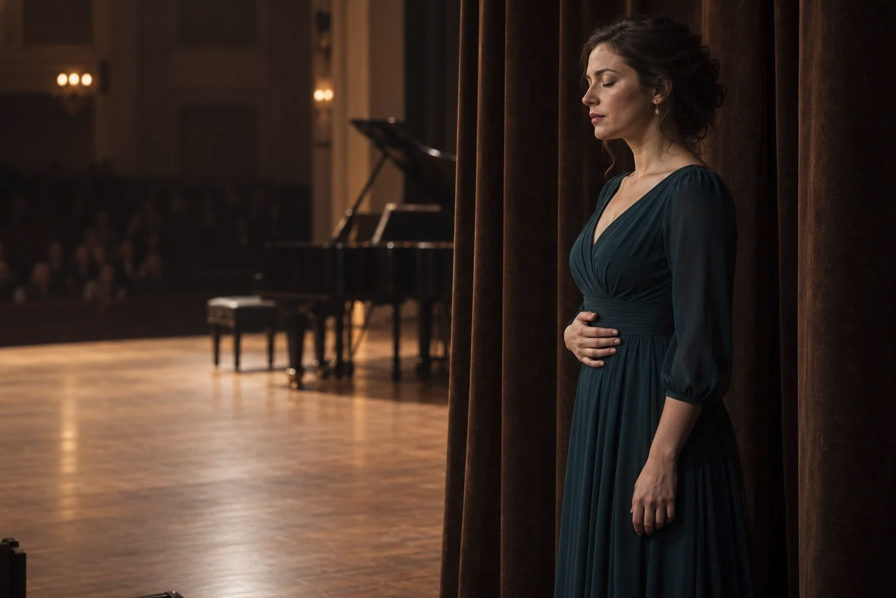
You have prepared, you know the piece, and you have worked through the difficult passages. And yet, just before you step onto the stage, your heart begins to beat faster. Your breathing becomes shallow, your shoulders rise, your hands tighten or tremble. Your attention shifts away from the music towards everything that could go wrong: “Will I remember it? Will I manage? What will they think of me?”
You may continue playing or singing while feeling that you have lost contact with your body. Something that felt natural in the practice room suddenly requires effort. You try harder, become more tense, and find it increasingly difficult to recover a sense of freedom.
This class begins with these real experiences of the musician. Through physical preparation, breathing practices, attention training, and the simulation of performance conditions, we develop practical, individual tools for before, during, and after a performance.
When All Your Attention Is on the Instrument
“I’m thinking about my fingers, the notes, the sound. I forget that I have a body.”
A musician may spend hours monitoring every detail of a performance without noticing that they are holding their breath, tightening the jaw, fixing the shoulders, or using more effort than necessary. Sometimes the instrument itself can become a kind of safe space: it can feel easier to focus entirely on it than to experience ourselves as the person standing in front of an audience.
In the class, we broaden attention so that it includes not only the instrument, but also the person playing it. We notice contact with the ground, physical support, movement, and breathing. We learn to recognise fatigue and unnecessary tension rather than overriding them in order to complete one more repetition.
Through gentle vocal exploration, instrumentalists can also discover how singing a musical phrase and connecting it with the breath may open different possibilities for articulation, phrasing, and musical expression.
When the Voice Does Not Respond as It Did in Rehearsal
“My breathing feels high, my larynx seems to rise and the sound becomes heavy. How do I recover without pushing harder?”
For singers, this experience can feel particularly personal because their instrument is part of their own body. Tension, fatigue, and emotional activation may be experienced through the breath, sensations in the throat, and the way the voice responds. Anxiety about whether a phrase will “come out” can lead to even greater effort, when what the singer is actually seeking is greater ease.
We work on recognising these moments and gently returning to physical support, breathing, and musical intention. We explore specific points of reference that can also be used on stage: feeling the feet on the ground, releasing an unnecessary contraction, using a brief internal cue, or returning attention to the musical phrase and to the person with whom we are communicating.
This work complements vocal training, with the aim of supporting greater ease in singing and greater awareness of effort. We do not attempt to manipulate the larynx by force or impose a single “correct” way of breathing. Instead, we learn to recognise what is creating difficulty and explore how we can respond with less pressure.
When Everything Has to Happen at Once in Opera
“I have to follow the conductor, remember the text, listen to the orchestra, move, inhabit the role — and somehow keep my voice free.”
An opera singer is required to coordinate many demands simultaneously. They may be singing a difficult phrase while walking, bending, embracing another performer, or expressing intense emotion. How can the singer remain available to the dramatic action without losing the technical points of reference that support the voice?
Through gradual practice, we integrate movement, text, music, and attention. We explore where unnecessary tension appears and how demanding moments can be prepared more effectively. We cultivate flexibility so that the performer can respond to what is happening on stage without attempting to consciously control every detail at the same time.
When Emotion Needs to Become Expression
“How can I move an audience without becoming overwhelmed by my own emotions?”
Artists often draw on personal experience: joy, loss, pain, memory. On stage, they need to remain open and vulnerable while also being sufficiently grounded to continue performing.
We explore the difference between experiencing an emotion and giving it artistic form. We learn to recognise emotion, choose how we wish to express it, and return to points of physical and mental support when the emotional intensity increases.
In this way, expression can gain greater depth and range without requiring the artist to exhaust their personal resources in every performance.
Nervous System Regulation: From Performance Mode to Recovery
“The concert is over, but my body still feels as though I’m on stage.”
Performance requires a particular state of activation. Concentration intensifies, the senses become more alert, the body prepares for action, and the musician may need to process many different demands simultaneously. This activation is not necessarily something to eliminate; it can contribute to energy, responsiveness, focus, and artistic presence.
The difficulty can arise when there is no gradual transition between intense performance and rest. Musicians may spend hours practising or performing in a highly activated state and then expect themselves to move almost immediately from high-performance mode to sleep, without the intermediate stages of slowing down, releasing accumulated tension, and recovery.
An important part of the class is therefore learning to recognise our own patterns of activation and developing ways to move more gradually between different states. We explore what the nervous system may need before performance, during periods of high demand, and after the performance has ended.
Through breathing, grounding, gentle movement, body awareness, meditation, sound-based relaxation, and other recovery practices, we create personal routines for preparation and decompression. The aim is not to suppress performance energy or eliminate every sign of anxiety, but to develop greater flexibility: to know how to activate when we need to perform and how to gradually come out of performance mode when the demand is over.
Practices Used in the Class
The work is adapted to each musician’s individual needs, their instrument or voice, and the conditions in which they are preparing to perform. Practices include:
Physical warm-up and gentle mobilisation, helping the body enter practice and performance with greater awareness and readiness.
Stretching and recovery practices, adapted to the individual body and the physical demands of musical activity.
Breath awareness and gentle breathing practices, without forcing the breath, with the aim of becoming more familiar with our own responses.
Grounding and physical presence, through awareness of contact with the floor, physical support, and bodily sensations.
Meditation and attention training, learning to recognise distracting thoughts and return attention to the musical task.
Guided visualisation and mental rehearsal, drawing on approaches also used in sports preparation to become more familiar with the demands of performance.
Personal pre-performance routines, together with strategies for recovering after a mistake or unexpected moment on stage.
Gentle vocal exploration, connecting breath, sound, and musical intention.
Nervous system regulation, developing awareness of activation, stress responses, slowing down, and recovery before and after performance.
Sound and Sound Therapy sessions, offering an experiential space for listening, relaxation, and decompression, with the intention of creating greater internal space for musical expression.
After the Concert: How Do I Release the Tension and Move On?
“The performance is over, but I’m still replaying it in my mind.”
Recovery concerns both the body and the way we process the experience. We make space for gentle movement, rest, and the transition from the intensity of the stage back into everyday life. We learn to observe what happened without turning every difficulty into a personal failure.
From a first student concert to a professional audition, a difficult performance benefits from structured reflection: What worked? What was challenging? What could I prepare differently next time? In this way, the previous experience can become useful information for the next one rather than something we remain trapped in.
We also explore the importance of slowing down after performance. Instead of moving directly from intense activation into everyday obligations — or expecting ourselves to fall asleep immediately — we develop ways of allowing the body and mind to gradually recognise that the performance demand has ended.
The aim is to develop tools you can genuinely use when you need them: before the first note, in the middle of a difficult phrase, when anxiety or tension appears, and when you step off the stage. To understand your own patterns of activation and recovery, and to feel that alongside your technique, your own body, attention, and awareness can become sources of support.
Led by Leonora-Christina Gaitanou