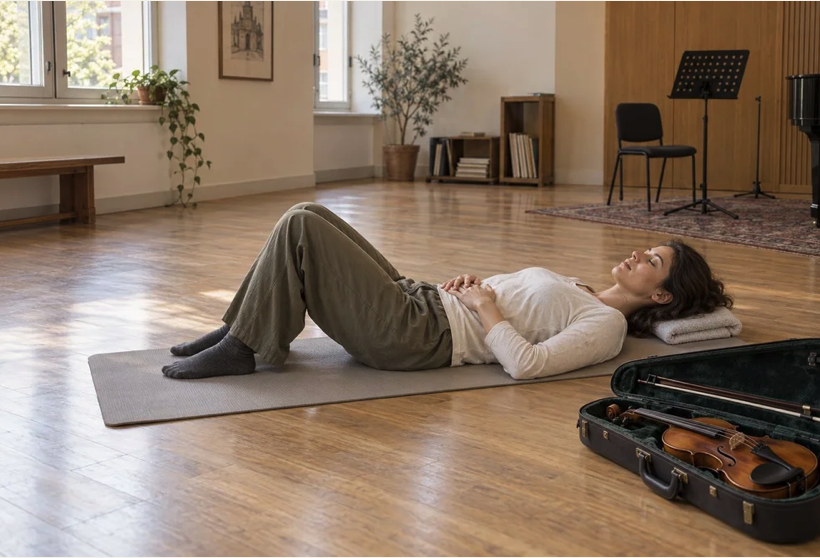
Nervous System Regulation
An important part of the class is nervous system regulation and understanding how the musician moves between different states of activation, performance, and recovery.
Musicians often become accustomed to functioning at a very high level of activation: intensive practice, rehearsals, performance pressure, heightened concentration, stage adrenaline, and the simultaneous processing of multiple musical and physical demands. After a concert or demanding rehearsal, however, there is not always a gradual transition out of this highly activated state. A musician may move almost directly from high performance mode to sleep, without allowing sufficient time for the intermediate stages of slowing down, releasing accumulated tension, and recovery.
The class explores how to recognise these different states and how to create more conscious transitions between them. Rather than expecting the body and mind to switch instantly from intense performance to complete rest, musicians develop personal preparation, regulation, and decompression routines before and after practice, rehearsals, and performances.
Through breathing, grounding, gentle movement, body awareness, meditation, sound-based relaxation, and other recovery practices, we explore ways of supporting the transition from heightened activation towards a calmer state. The aim is not to eliminate the natural activation that accompanies performance — which can be an important source of energy, focus, and artistic presence — but to develop the ability to move more flexibly between activation and recovery.
In this way, musicians learn not only how to prepare themselves to perform, but also how to come out of performance mode: to slow down gradually, release physical and mental tension, recognise what their system needs after intense concentration, and create the conditions for genuine rest and recovery.
Physical Preparation, Recovery & Stage Presence
This class offers musicians a space to reconnect with their bodies and breath, cultivating focus, freedom of movement, and confidence on stage. Through gentle physical warm-ups, mobility exercises, stretches adapted to individual needs, and recovery practices, attention is given both to preparation before practice or performance and to recovery afterwards.
When attention is constantly directed towards the instrument, the score, and technical accuracy, held breath, unnecessary tension, or fatigue can easily go unnoticed. Through body-awareness and grounding exercises — developing a sense of contact with the floor and physical support — musicians learn to recognise these signals and respond more effectively to their individual needs.
The class incorporates conscious breathing, awareness of bodily sensations, meditation, guided visualisation, and mental rehearsal of the performance experience. We also draw on preparation strategies commonly used in sports, including attention training and the development of a personal pre-performance routine.
Gentle vocal exploration invites instrumentalists to connect breath, musical phrasing, and physical presence. In addition, sound-based relaxation and sound therapy sessions create space for deep listening and experiential relaxation, helping to release mental and physical tension. This can be particularly valuable for musicians, who are often processing multiple simultaneous demands while producing sound — technique, rhythm, notation, interpretation, listening, movement, and communication.
For singers, particular attention is given to the relationship between body, emotion, and voice. We explore how to recognise tension as it arises and how to return to a calmer, more available state without attempting to forcefully control either the breath or the sound. Musicians develop the ability to distinguish between the emotions they experience and the expressive choices they make, allowing emotion to be transformed into interpretation without losing connection with vocal technique.
In opera, where music, text, movement, stage direction, and communication with the conductor and fellow performers all coexist, we practise gradually integrating these different demands. These practices complement vocal training, supporting greater ease, awareness, and economy of effort.
The aim is for each musician to develop a personal toolkit: to prepare the body and mind for performance, regulate activation and anxiety, regain focus when needed, and gradually come out of performance mode afterwards. By learning to recognise their own patterns of tension, activation, slowing down, and recovery, musicians can approach practice and performance with greater awareness, stability, and resilience — remaining connected to themselves while communicating through music.
Led by Leonora Christina Gaitanou